
Budgets, Bills, and Birds
What do the Long-billed Curlew, Canada Warbler, and ‘Akeke‘e have in common? They all benefit from funds coming from the U.S. federal budgeting process.

Poecile gambeli
Ischíkiikaate (Apsaalooke for “chickadee”)

Any season of the year, the Mountain Chickadee is a delight to encounter. In their breeding season, they form neighborhoods of adjacent territories in the conifer forests of western Canada and the U.S., which ring in the early spring dawn with dozens of cheerful whistled songs. In winter, groups of Mountain Chickadees are joined by other birds — nuthatches, woodpeckers, creepers, kinglets — to form large dispersed flocks that move together through the forest, following the chickadees’ namesake rallying call.
Mountain Chickadees are social birds, living in groups of up to three mated pairs and juveniles of the last breeding cycle for most of the year, only breaking off into territorial pairs for the breeding season. In fact, while we tend to think of the breeding season as the time when mates are chosen and territories are established, most of this actually occurs in the winter. This is when the social hierarchy is solidified between the individuals in a group, and come spring, the dominant birds will reliably take the best territories. While boundaries may shift somewhat, the same birds will usually hold the same territories year after year. Pair bonds are formed during the winter as well, and usually last for as long as both birds survive.
Mountain Chickadees are well-known for their caching behavior. To survive harsh mountain winters, these chickadees hide surplus food throughout their winter territories, a behavior known as “scatter hoarding.” A single chickadee may cache tens of thousands of food items — insects, conifer seeds, or goodies from bird feeders — over the course of a year. They may cache food any time they have extra, and may recover caches any time of the year, but spend the most time caching in the fall, and the most time eating from them in the winter. In fact, studies have shown that Mountain Chickadees living in harsher winter environments have better spatial memory and are more adept at remembering where they have cached food. Unsurprisingly, these birds also survive longer.
Mountain Chickadees are not considered a species of immediate conservation concern, given their larger population size and broad distribution. However, populations have declined over the last 60 years, and Partners in Flight notes the species as a Common Bird in Steep Decline. Though the causes for this species’ decline are not fully understood, climate change and loss of forest habitat may each play a role.
Unsustainable clearcutting operations and land development locally remove valuable habitat for this species. Fortunately, the montane coniferous forests that these chickadees largely depend on are widespread and not currently believed to be at risk.
Climate change appears to be an emerging threat to this species. Extreme weather may weaken the populations of insects these birds rely on, particularly at higher elevations and in the more extreme habitats where these chickadees live. Winters with high snowfall can keep insects buried through the spring, while dry summers kill off insects during their breeding season. Paradoxically, both extremes are becoming more common with climate change, a phenomenon sometimes referred to as “weather whiplash.”
Given its wide distribution and larger population size, the Mountain Chickadee is not generally considered to be a species in need of immediate conservation action. However, this species benefits from projects that improve or create suitable forest habitat within its range, and such actions have positive, ecosystem-wide outcomes. Bird feeders stocked with healthy seeds and suet can support Mountain Chickadees and other species, especially in winter, and these chickadees will readily use nest boxes.
Mountain Chickadees need healthy forests and are particularly reliant on conifers. There is some evidence that Mountain Chickadees can thrive in forests following wildfires, which historically occurred naturally or were sometimes set intentionally by Indigenous communities, but repeated burning can severely degrade habitat and prevent forest regeneration. The use of bird-friendly conservation practices can support the long-term health of forests and prevent repeated, catastrophic wildfires that are becoming more common as our climate changes.
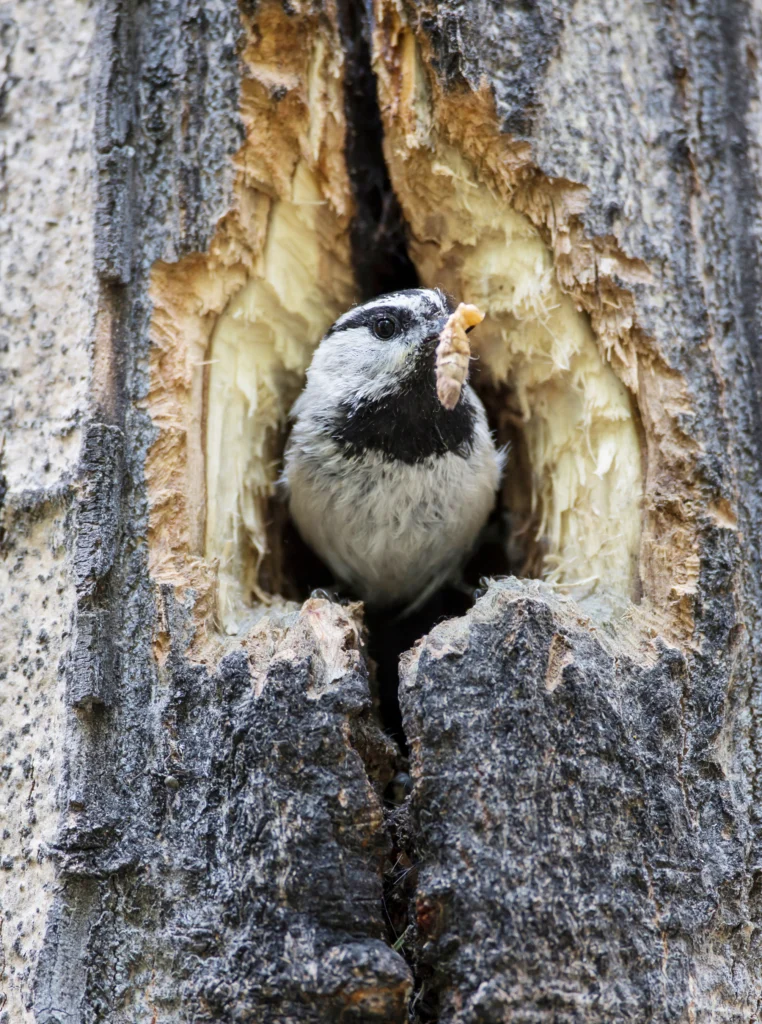
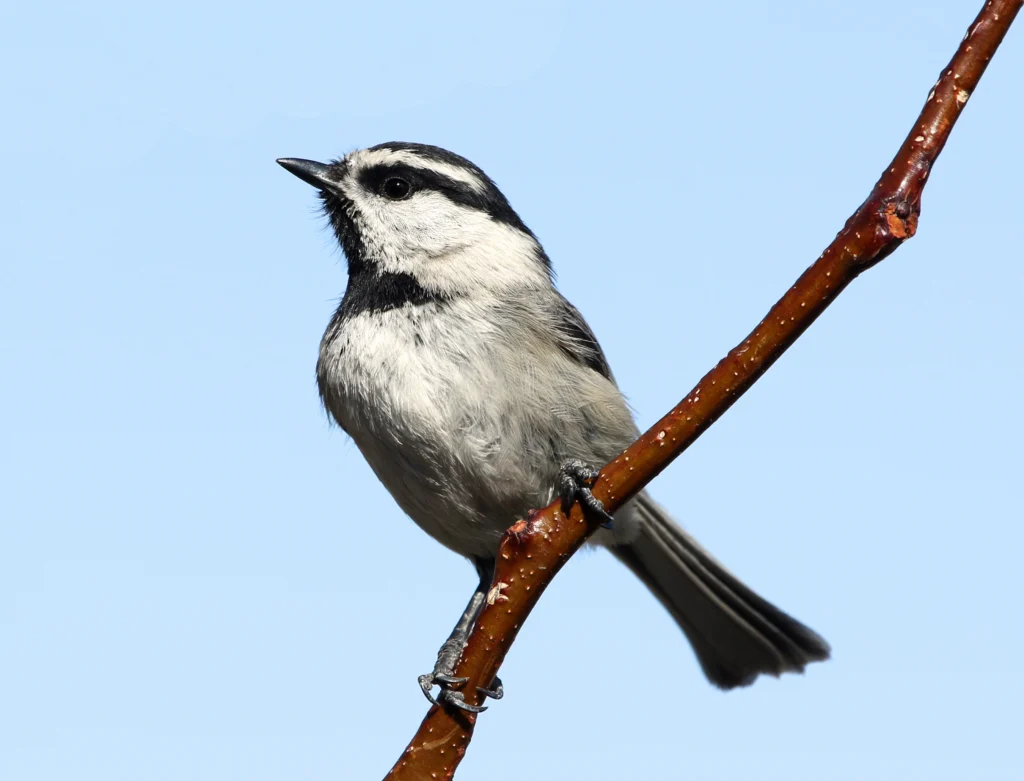
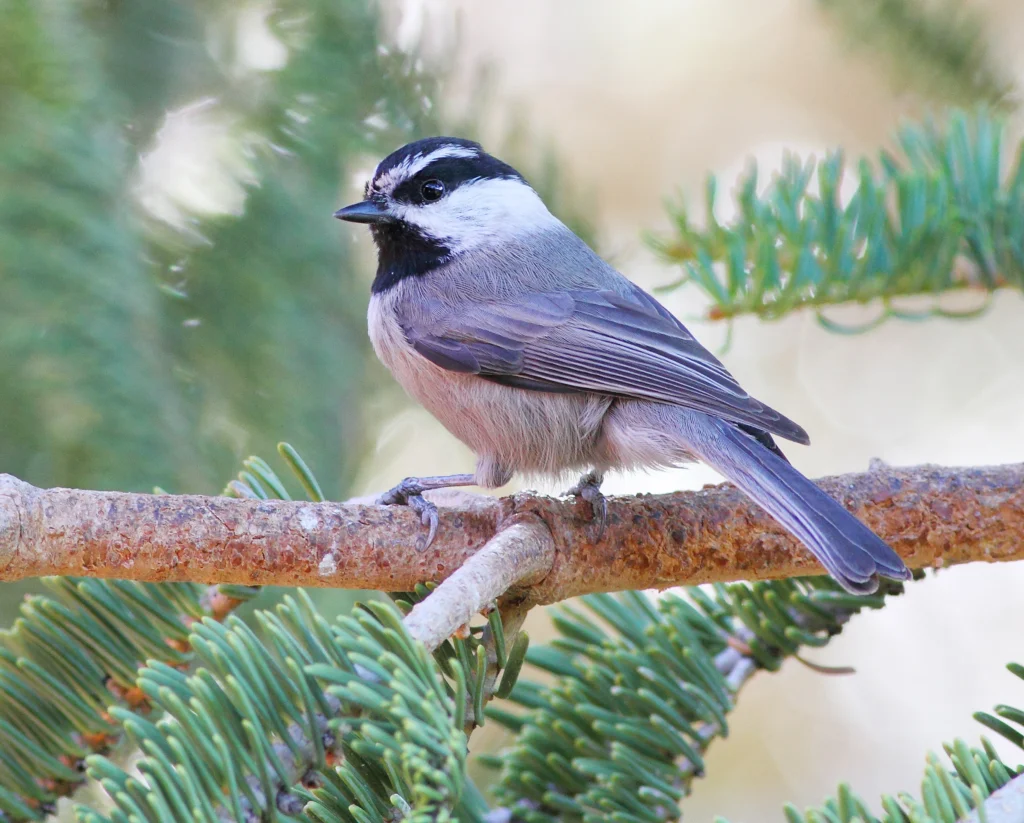
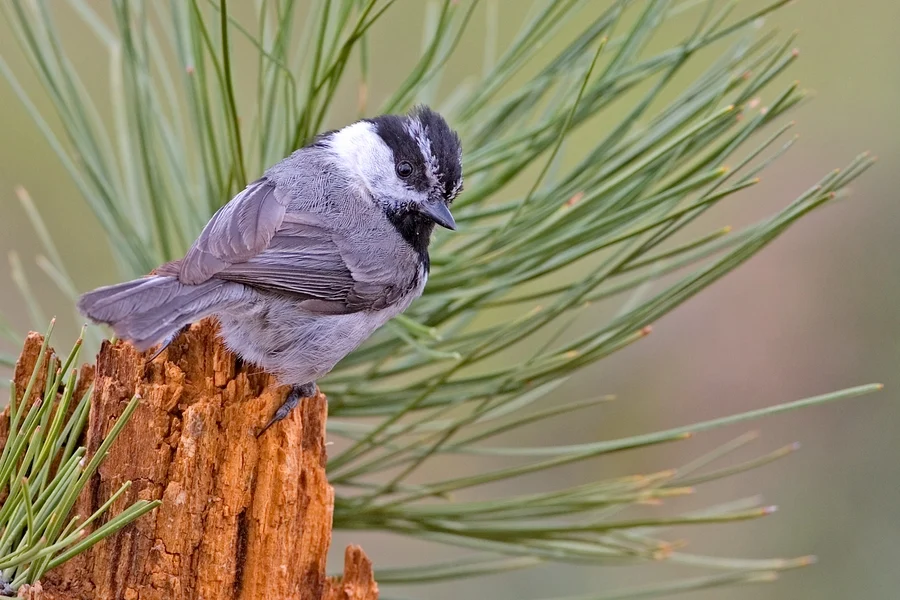
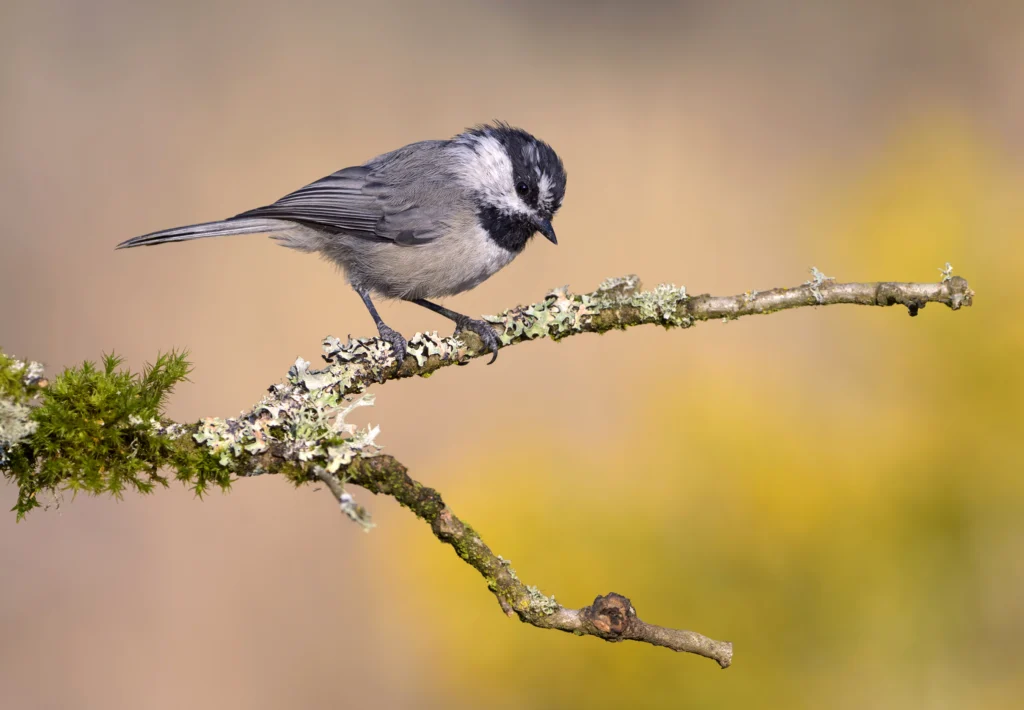
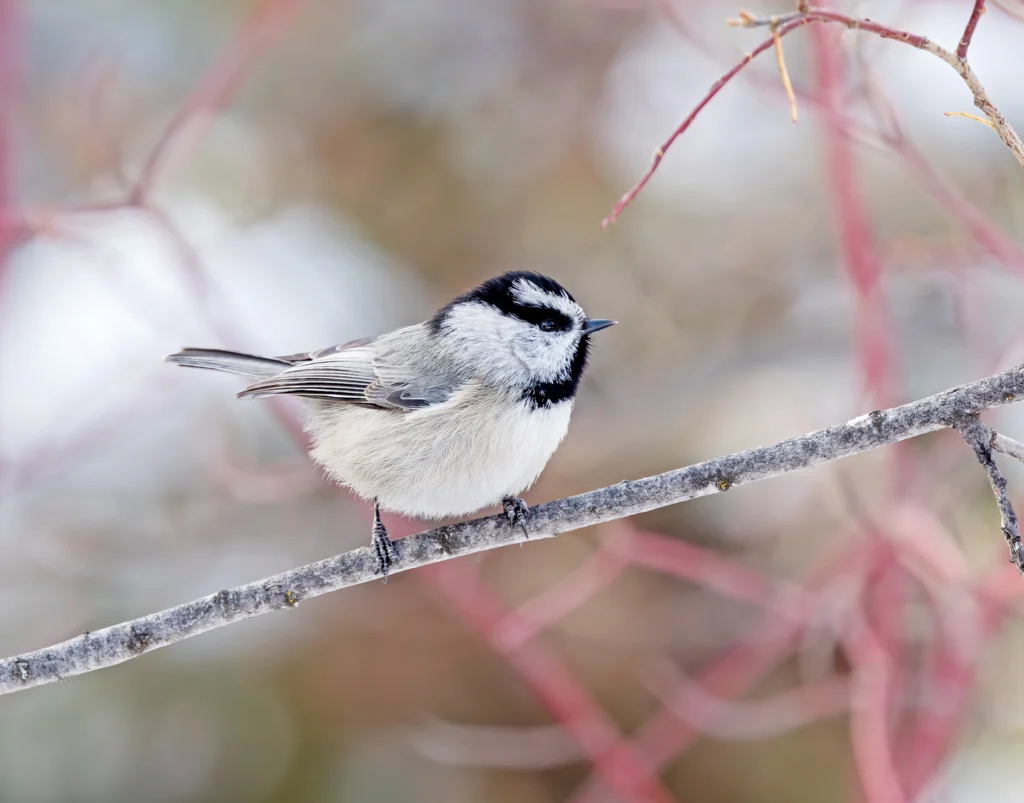
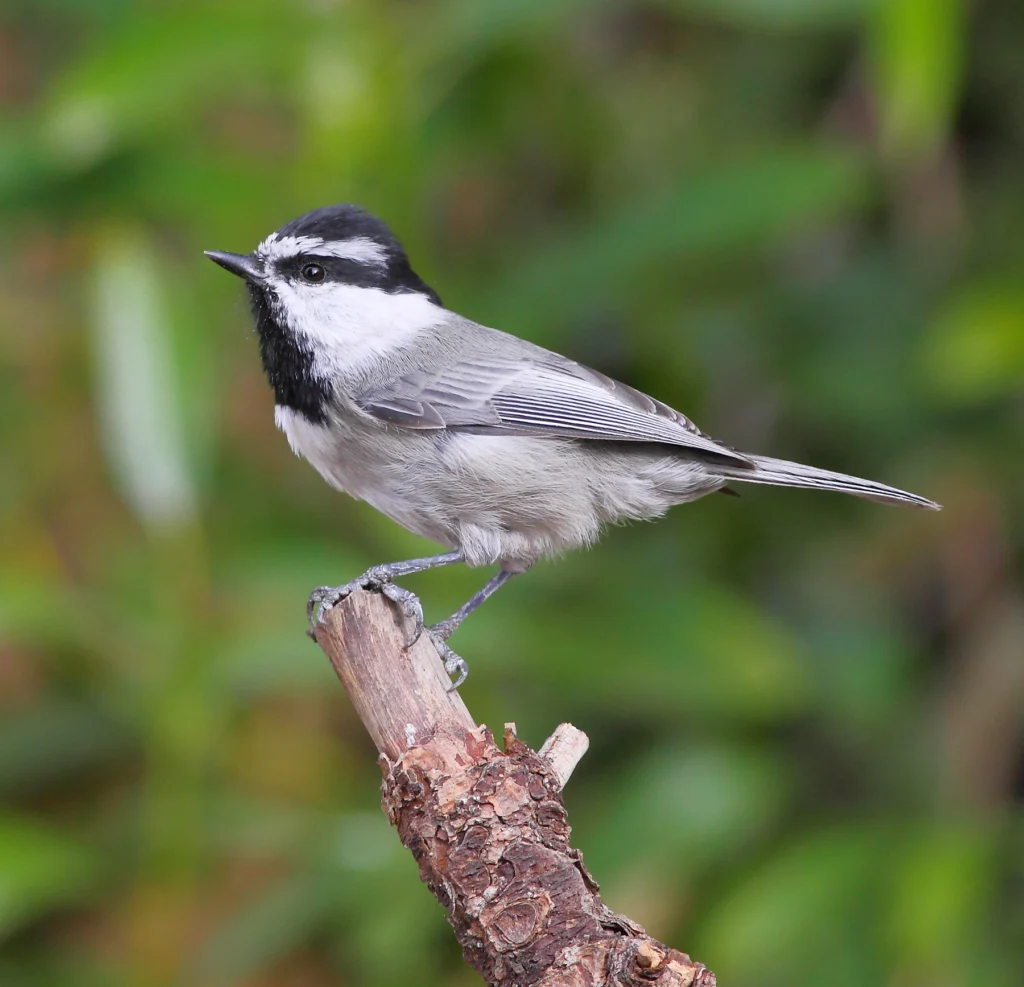
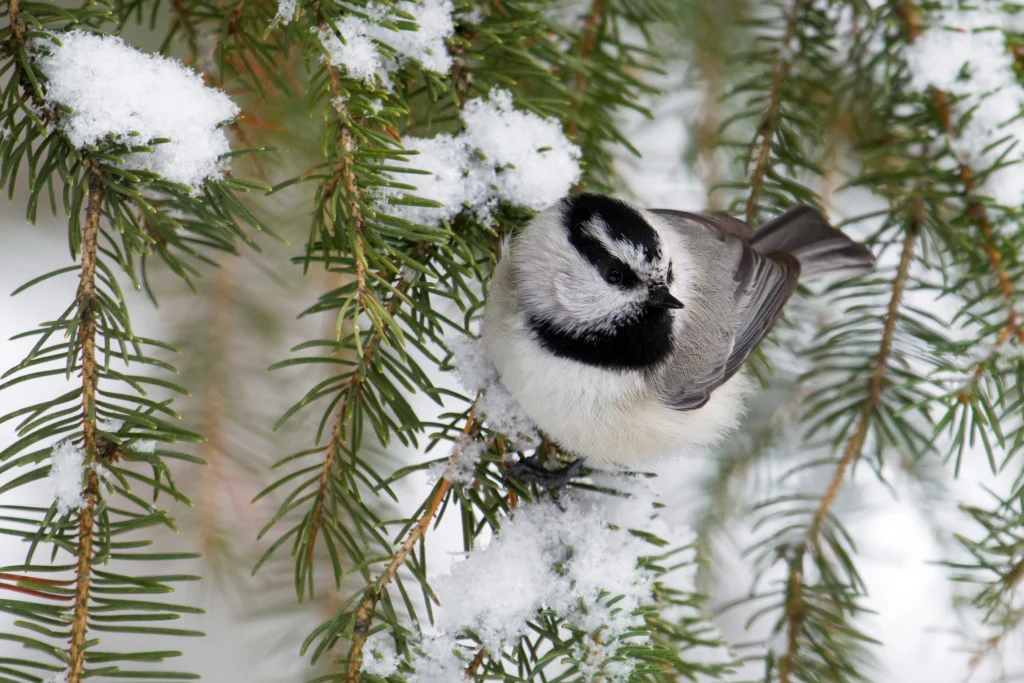
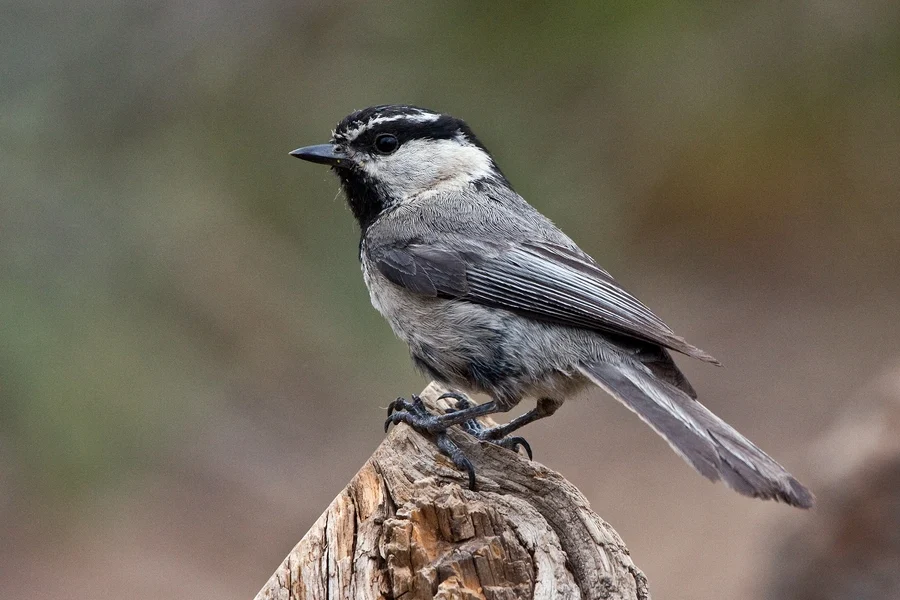
Similar to other chickadees, the Mountain Chickadee is patterned simply, with a black “bib” on the chin and throat, a black “cap” from the crown to just below the eye, and white on the sides of the head. A thin white stripe or “eyebrow,” running from the beak above the eye and across each side of the head, easily distinguishes this species from the other North American chickadees. The back, wings, and tail are gray, and the breast, belly, and flanks are typically whitish gray, sometimes slightly tan.
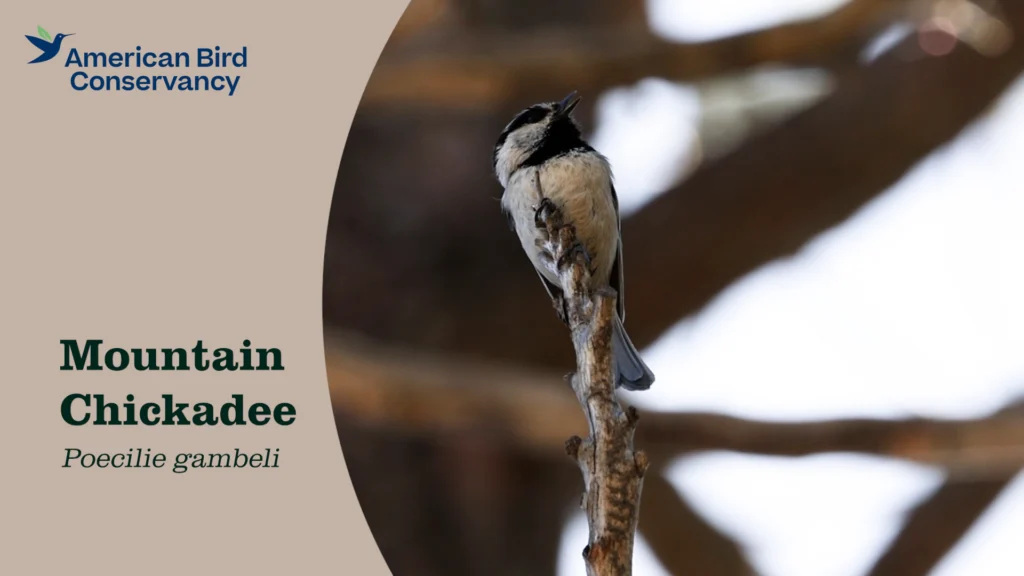

The Mountain Chickadee’s song is a clear, musical whistle, consisting of two to six notes at one to three frequencies. Within these parameters, the sweet song of this species is quite variable throughout its range. As with other chickadees, this species also gives several distinct calls, delivered with a great deal of flexibility depending on the specific context. The classic “chick-a-dee” call consists of any number of rapid, high-pitched notes (“chicka” notes) followed by any number of longer, nasal, lower-pitched notes (“dee” notes). “Gargle” calls are rapid and complex, often covering a wide frequency range and including both clear and harsh notes.
Credit: Richard E. Webster, XC350723. Accessible at https://xeno-canto.org/350723.
Credit: Bill Pyle, XC1047618. Accessible at https://xeno-canto.org/1047618.
Credit: Sue Riffe, XC368495. Accessible at https://xeno-canto.org/368495.
Year-round, Mountain Chickadees primarily inhabit montane coniferous forests, but will also use areas with deciduous trees, including aspen groves and riparian areas.

Specific Area
Western North America, from Canada into Baja Mexico
Range Detail
The Mountain Chickadee ranges throughout the western mountains, including the Rockies, Cascades, Sierra Nevada, Peninsular Ranges of California and Baja California, the Basin and Range mountains of the Southwestern United States, and smaller isolated ranges.
Did you know?
Over much of their range, Mountain Chickadees overlap with their closest relative, the Black-capped Chickadee. Where this is the case, even when territories overlap, the two species avoid competing with each other by focusing on different resources. Mountain Chickadees forage mostly on conifers and nest higher and in larger trees, while Black-capped Chickadees forage more on deciduous trees and nest lower. However, at shared resources such as bird feeders, Black-capped Chickadees are usually dominant, aggressively displacing their conifer-loving cousins.
Mountain Chickadees tend to make their presence known, whether by foraging restlessly among conifer branches or announcing themselves with their bright whistled song or namesake call. In winter and fall, they form conspicuous flocks, often attracting other resident and migratory species to forage alongside them. They are also well-known for recruiting huge multi-species assemblies when mobbing a raptor such as a Sharp-shinned Hawk or Northern Pygmy-Owl, and their agitated calls may be a good clue to humans that such a predator is nearby.
In the warm months, Mountain Chickadees eat mostly insects and spiders, which they glean from foliage and twigs, often while hanging upside down. Preferred insects vary regionally, but often include moth caterpillars, sawfly larvae, beetles, aphids, and scale insects. When insects aren’t available, they rely on conifer seeds. Like most chickadees, Mountain Chickadees store food in thousands of caches throughout the year, which they use to supplement their diet through the winter.
Mountain Chickadees are monogamous and typically mate for life, although females will sometimes “trade up” for a newly single, higher status bird. Courtship is limited in this species, perhaps because pairs and juveniles will flock together through the winter, allowing birds to assess each other and sort out their social hierarchy. Pairs usually form in these nonbreeding flocks, and typical courtship behaviors such as springtime song seem to serve a largely social function in the larger “neighborhood” of nesting birds. Males will feed their mates, but mostly long after pairs are formed, so this is most likely for nutrition rather than courtship.
Mountain Chickadees typically nest in tree cavities, either naturally occurring or previously excavated by woodpeckers, but will readily use nest boxes. A male will bring his mate to the nest cavities on his territory, but she will ultimately make the decision as to where she will nest. While males will bring nesting material, females build the nest. The nest itself is composed of a base of soft material, such as wood shavings or lichen, which the female loosely tops with fur.
A mated female will lay 6 to 12 eggs, which she alone incubates for about two weeks. When not incubating, she covers her eggs with a “plug” of fur. Throughout laying and incubating, her mate will bring her food. When he does, the female will sometimes leave the nest and follow him around while he forages, calling and fluttering her wings, similar to begging fledglings. While she follows him, the male will give her any food he finds. After hatching, nestlings remain in the nest for about three weeks.
Related News & Stories


Join the flock! Your donation helps preserve the habitats that birds need to survive.