Cats are beloved family pets, faithful companions, weird little guys whose antics fill our photo rolls on our phones, and our hearts. Their purrs and chirps, their adorable biiig stretches, the pitter-patter of their approaching paws that we find so endearing make it easy to forget that cats are carnivores. Dangle a feather toy or toss a catnip-filled stuffy to your cat, though, and you’ll quickly remember that they can be fearsome hunters. But even the toughest cats are no match for run-ins with predators, collisions with vehicles, diseases, and other dangers outdoors. As many as 100 million cats roam outdoors in the U.S. It’s a massive problem for wildlife, public health, and for the cats themselves. Life outdoors, even part-time, is hard on cats.
That’s just one of many reasons American Bird Conservancy (ABC) encourages treating cats like we treat dogs: A majority of dog owners keep their pups indoors and make sure they are supervised and kept under our control — on a leash or run, in a fenced-in yard or catio, or even in a stroller — when they do go outside. Why? Because it’s safer for dogs, people, and other animals. At ABC, we think cats deserve that same level of care and supervision. (Cats, for the record, also think they deserve all of that, and more.)
That’s why the ABC flock isn’t kitten around when it comes to keeping cats indoors. Meet the cats behind the bird conservation experts! Learn how the ABC team keeps their indoor cats happy and get our flock’s tips for helping your cat explore the outdoors with you in a way that’s safe for them, and for wildlife.
Meet Rosco and Pepper
Pet Parent: Liz Virgl, ABC’s Texas Coastal Program Manager
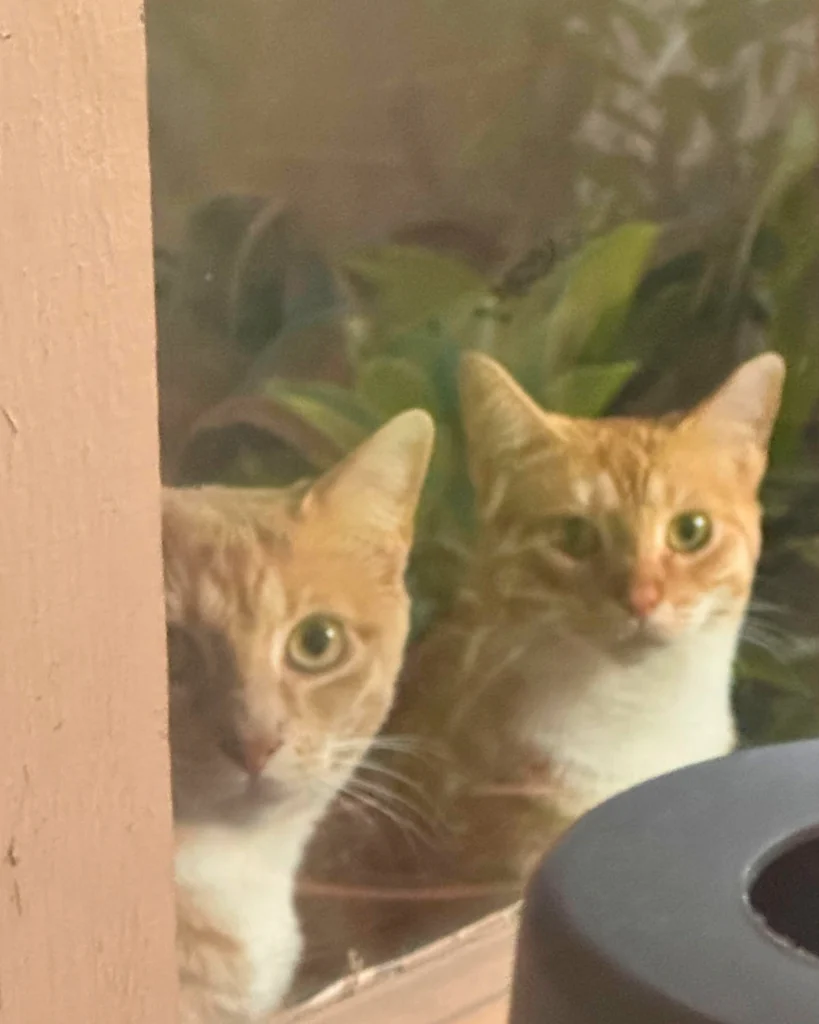
Rosco and Pepper look like twins, but they found me independently. Rosco was only six weeks old when he made his way to me, and we found Pepper in a parking lot months later, after Hurricane Beryl. Pepper adjusted to being indoors easily — she loves it inside — and Rosco probably doesn’t remember much from his brief time outside.
Favorite Toys: Rosco and Pepper love Matatabi sticks (safe, natural chew toys with a catnip-like effect), cardboard boxes, and springs. We avoid giving them plastic toys.
Why They’re Indoor Cats: I see a lot of strays that are starving and injured at our cleanup sites, and it pulls at my heartstrings for the ones I have to leave behind. We saved one whose tail was half burnt off, and luckily, we were able to rehome them. It’s not a great life for them outdoors.
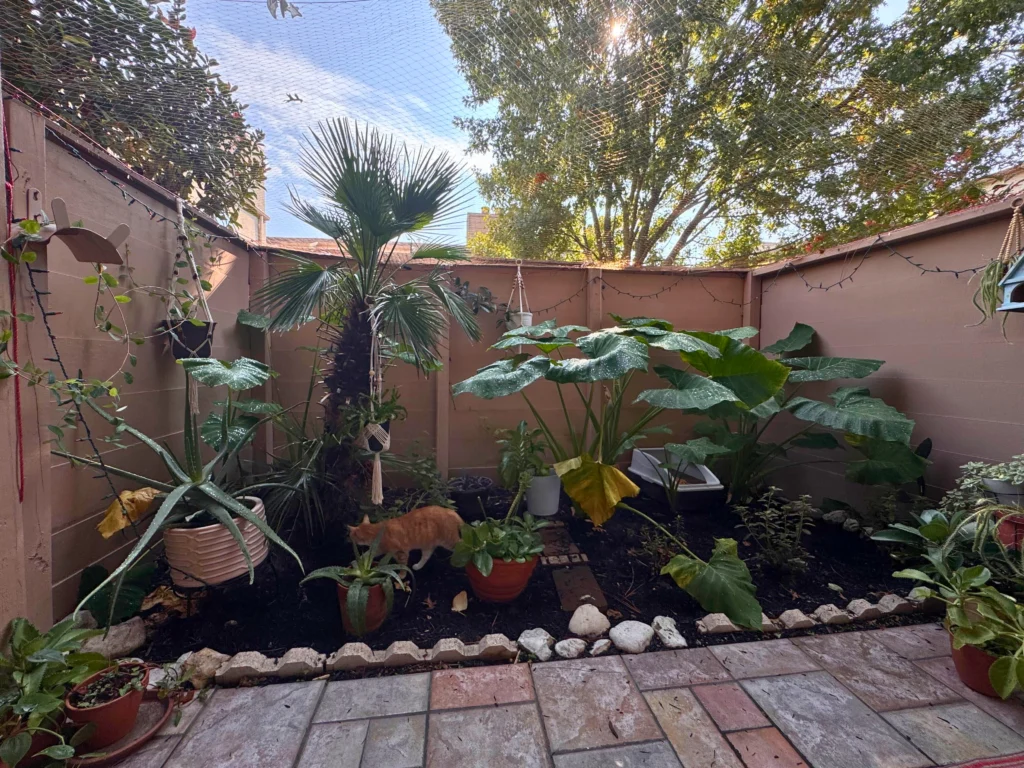
How They Explore Outdoors: Both Rosco and Pepper tend to be timid on their leashes and need some time in a quiet spot to warm up to being outside. We also have a net over our enclosed porch space for them to get some fresh air at home.
Meet Midnight and Penny
Pet Parent: Michael Paling, ABC’s Michigan Forester
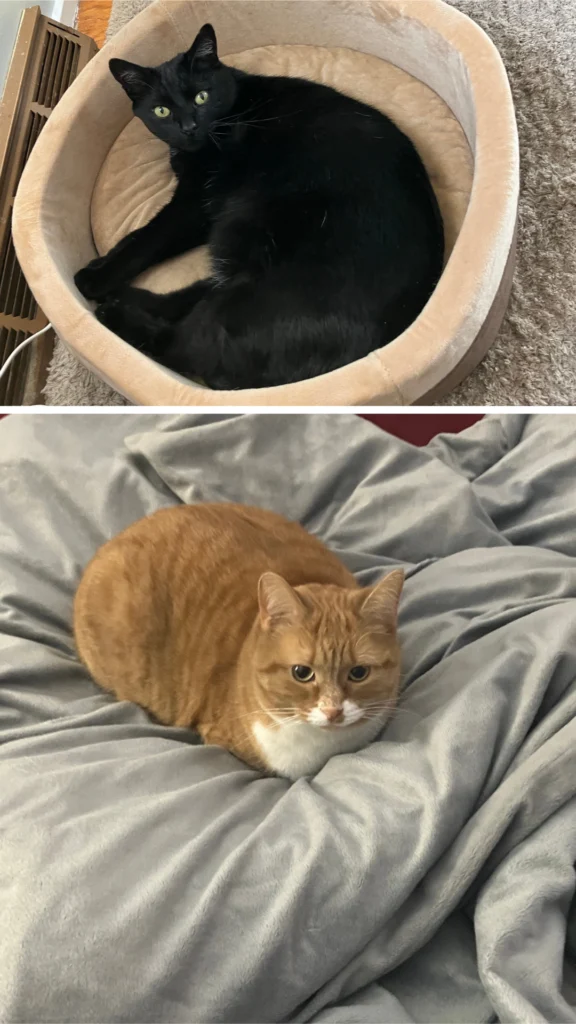
I have had Midnight (now almost 9 years old) since he was a tiny kitten. Midnight was born in spring 2017, when I was renting an apartment built into a pole barn in the backyard of a sweet older lady. She got two kittens to keep around the garage, but the kittens started entering her house through the dog door. She opted to rehome them, and I took Midnight. Penny was adopted from a local pet shelter in 2023 to be a friend for Midnight.
Favorite Toys: Their favorites are the 6-foot tower I built and the heated cat bed. I have another three scratching posts and towers, tons of tiny toys, and a water fountain that I think they like more than their plain old dishes. The toys they play with the most are wands with feathers attached (when I’m playing with them), a box with fake grass and a jingly ball inside, and a fabric bag. It’s so funny to watch Midnight try to pounce on nothing inside this bag! Penny will also find random things to lie on: My coat, my empty guitar case, the box of fake grass, rugs, whatever! “If I fits, I sits” is a suitable saying for her.
Why They’re Indoor Cats: Penny has always been an indoor cat. For the first couple of years of Midnight’s life, he was an outdoor cat. I have memories of him bringing me birds swinging from his mouth, looking so proud of himself. Then I was hired by ABC, learned about the issues with cats, and Midnight’s been inside ever since. Before that, Midnight would occasionally disappear for a couple of days at a time. He’d always come back, but sometimes he’d have injuries from fighting. He also once became infected with a bot fly larva, which we had to remove and then treat his wound. I used to want to let Midnight run free outside, so I didn’t keep him “cooped up” inside, but he does just fine being indoors. Both my cats stay inside now.
How They Explore Outdoors: Both Midnight and Penny are strictly indoor cats now. When Midnight was transitioning to life indoors after years outside, he had occasional access to a small deck 12 feet off the ground, high enough that he wouldn’t jump.
Meet Piper and Tiger
Pet Parent: Sarah Belles, ABC’s Gulf Coast Avian Ecologist
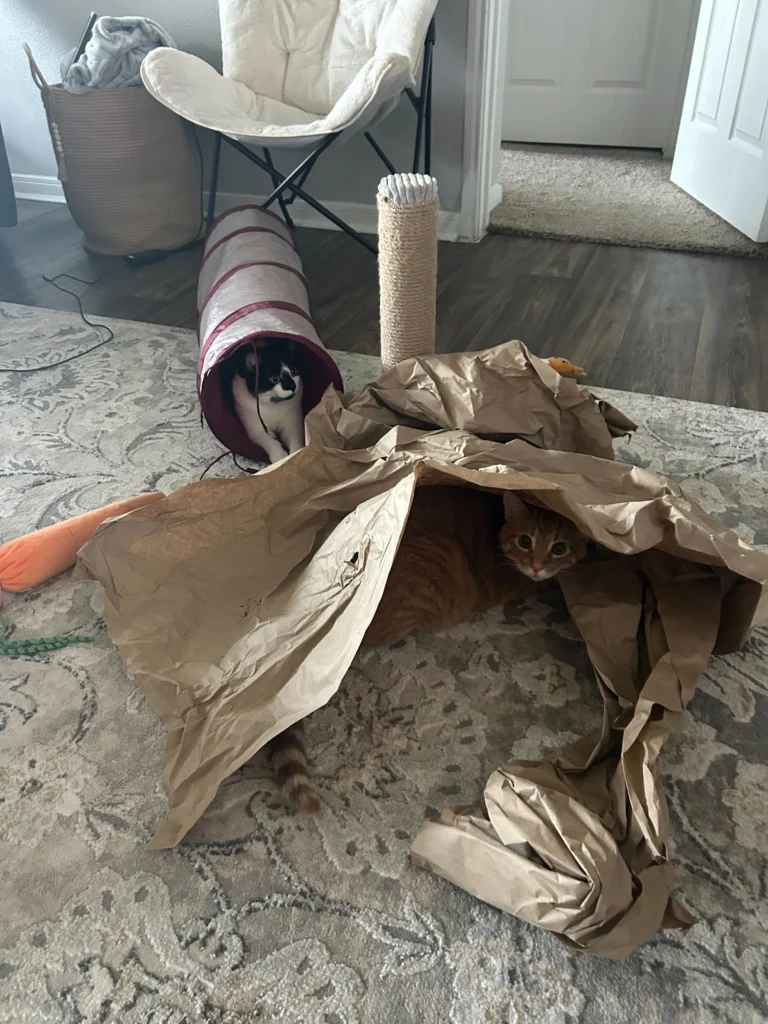
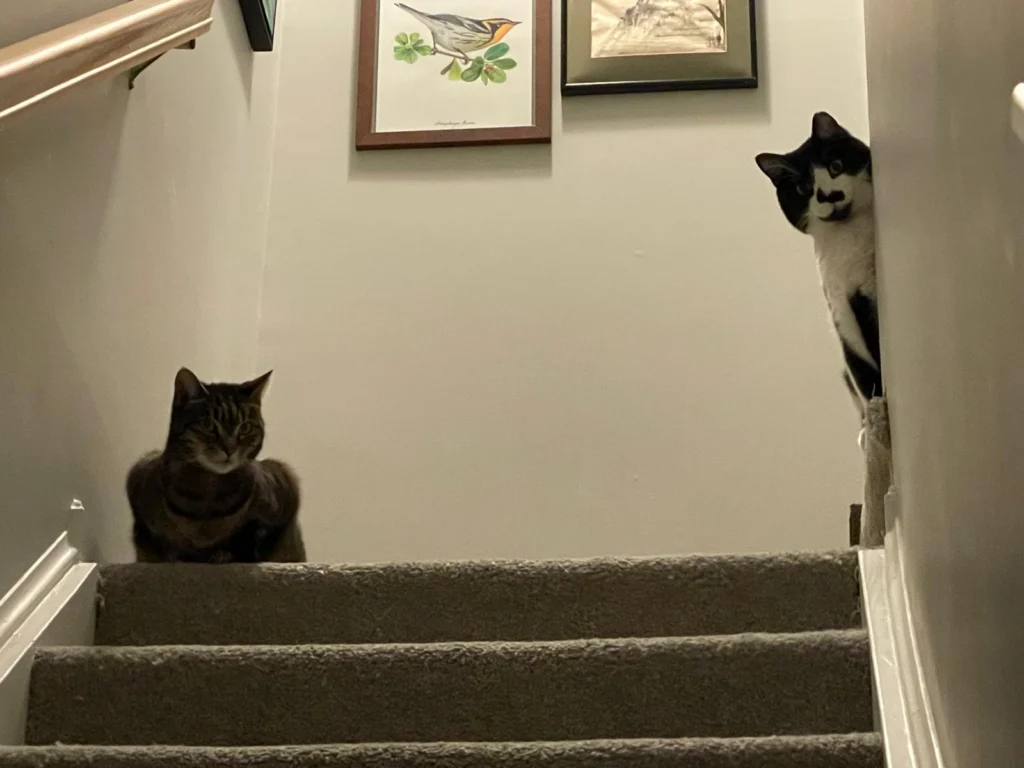
Piper (our black and white cat) showed up under my parents’ deck after a freezing cold night. Piper (aka Pipey, Miss P., or simply P.) was only about 2 months old at the time. Our orange cat, Tiger (aka Tigey, Mister Boy, or Meeester) came from a shelter and was adopted by my partner. Both are about 2.5 years old. Piper can be stubborn and feisty, but she’s a “people cat” who loves to “talk” back and forth with me and is a big snuggler. Tiger is more cautious and calm, but he loves to play and run around with Piper when he’s in the mood. He’s very attached to his dad.
Favorite Toys: We have two big cat towers in different rooms that our cats adore, and we have window hammocks in two of our windows. They have lots of scratching pads, a tunnel, and tons of toys that provide different types of enrichment. We also dedicate time each day to play with them and satisfy their activity needs.
Why They’re Indoor Cats: Keeping my cats indoors protects them from harm from diseases and other animals. It also keeps them from walking across roads and being hit. Since cats are also one of the top threats to birds, I feel good about protecting the birds and my cats from harm. Piper took to being indoors immediately. As long as she was around her people and other animals, she was content. We’ve always provided ample enrichment options and playtime, which helps a ton. Tiger loves to look out the window at the scenery outdoors. As a compromise, we take him out for supervised “balcony time” where he can take in the smells and sounds of the outdoors.
How They Explore Outdoors: We take our cats out on our fourth-floor balcony, where they are free to move around, but are confined to a smaller area. They are supervised the entire time and love to explore and roll on the concrete. Sometimes they get overwhelmed by the sounds outdoors. We like to keep the door cracked when the weather is good enough to give them the option to retreat to the safety of indoors.
Meet Boekeloo
Pet Parent: Nicole Schafer, ABC’s Kirtland’s Warbler Recovery Forester
I have had Boekeloo since she was about eight weeks old, when she showed up in the flower box on my deck. Boekeloo, who is now four, seems to have chosen her own home, and that sassiness and curiosity have stuck around. She decides when she gets attention.
Favorite Toys: Boekeloo loves her cat tower, which is situated next to a window with a front row seat to the birdfeeder. She also has a window perch, multiple windows with beds, an activity feeder, and open screened windows when it’s nice outside.
Why She’s an Indoor Cat: Boekeloo stays inside for her own well-being and safety, but also to prevent her from predating other animals. Though she started life as an outdoor cat, I transitioned her to life indoors by taking her for walks with our dogs for the first few weeks I had her.
How She Explores Outdoors: Boekeloo has a harness and leash, but she is very cautious going outside and almost crawls to be low to the ground. If she hears any loud noises, she goes sprinting back indoors. We had a rental for a time that had a self-built catio with ramps that went up three levels. We left the window open just enough for her to get in and out. She spent most of her time out there.
Meet Frank and Cato
Pet Parent: Sussy De La Zerda, ABC’s NetSuite Grants Administrator
Frank (our brown tabby) is about nine years old, and Cato (our black and white cat) is about eight. I found and rescued both of them at random when they were just a few weeks old. They each took to living the good life indoors and seemed very happy to be adopted and living inside a house. That sounds like a sweet deal for two cats who typically prefer to lounge and sleep! Fittingly, Frank’s favorite pillow is a birding field guide.
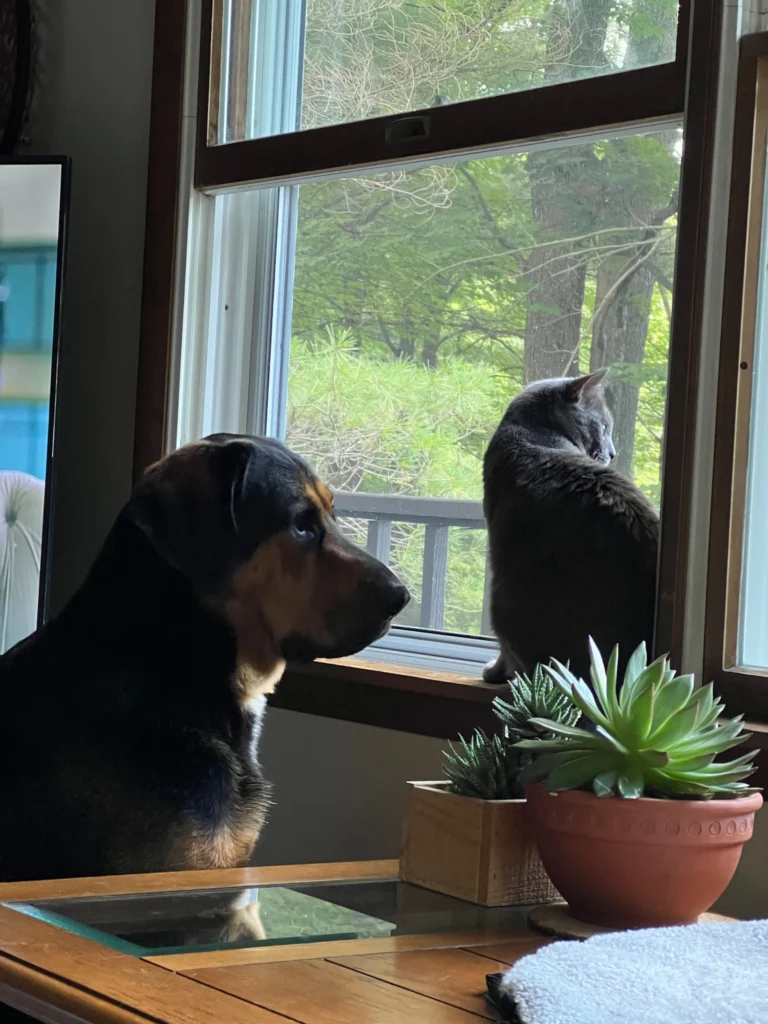
Favorite Toys: Frank likes cardboard boxes and boxes to scratch — Cato, not so much, but both enjoy cat toys, like ribbons and mice with catnip. They also enjoy standing by the window and the glass door to see what happens outside.
Why They’re Indoor Cats: It is safer for them, and of course safer for birds and other wildlife. We tried a leash and harness, but they didn’t like it.
Meet Monty
Pet Parent: Elizabeth Mullen, ABC’s Minnesota Wildlife Forester
Monty is a distinguished gentleman at almost 17 years, but he’s in great health. I adopted Monty, who had lived outdoors for around six months before becoming an indoor kitty — and he adjusted to life inside beautifully. Monty is an expert mouser (indoors only!), has a deep love for food (any and all kinds!), and is a well-traveled cat who loves a good car ride.
Favorite Toys: I engage my cat via various games: hiding treats for him to find, tossing treats for him to chase after, and having birdfeeders near the window for him to view wildlife. He has one cat tree and several cat beds in different spaces, both private and in the open.
Why He’s an Indoor Cat: Monty stays indoors for the health of my local wildlife and for his health. Also, no one wants their cat to bring in fleas! My parents allowed our cat to be outdoors, and we brought him in during the evening. Being attacked by raccoons was pretty traumatic, an experience I do not want for my own cat.
How He Explores Outdoors: At 17, Monty is old enough that he has no desire to explore far from me. He goes outside with me during the warm season, but he is strictly supervised. He mostly eats grass and flops around in the warm spots.
Meet Penelope
Pet Parent: Rebekah Rylander, Rio Grande Joint Venture Science Coordinator
Penelope is the queen of her household and only has eyes for her mama. Now 13.5 years old, Penelope was given to me as a gift in graduate school, but before that, she had been a “street kitty.” She was caught in a “Havahart” trap at a few months old and transitioned easily to life in the lap of luxury indoors. She’s very talkative when she’s hungry, prefers to spend most of her time watching birdfeeders from the window, and loves to burrow into suitcases when I’m packing for a trip.
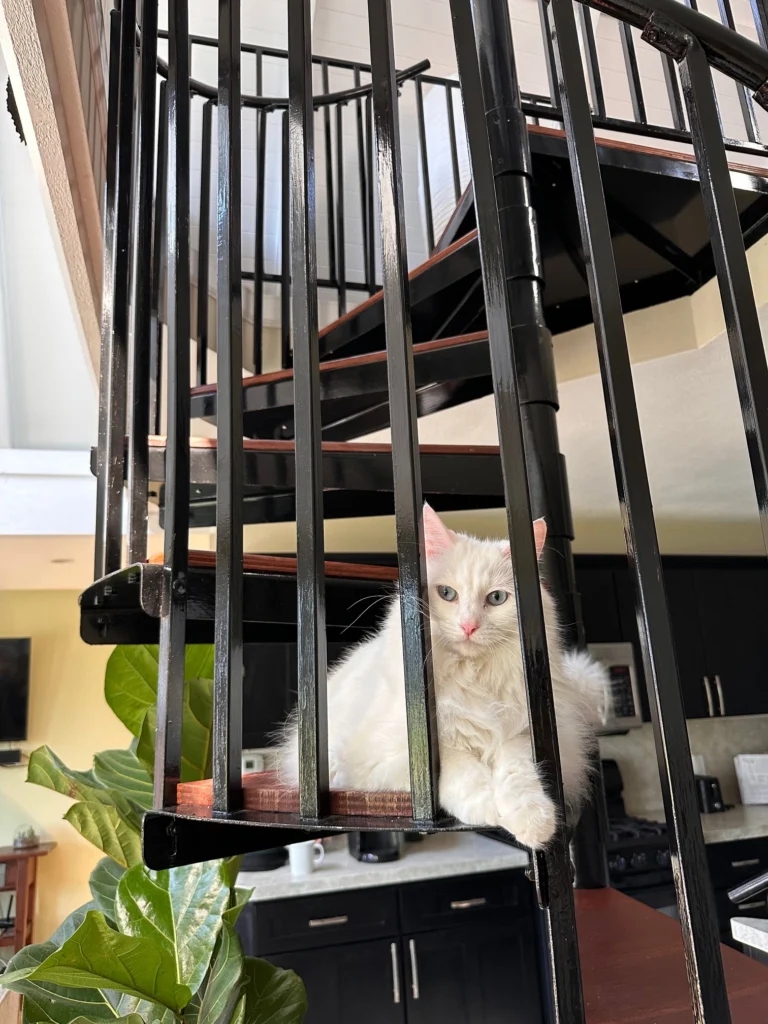
Favorite Toys: Penelope’s not a huge fan of toys, but she gets plenty of stimulation watching birds and other critters out the windows. She also loves to run up and down my spiral staircase like it’s a large cat tower.
Why She’s an Indoor Cat: Birds and other critters did not evolve with domestic cats occupying the same niches and habitat that they have for tens of thousands of years. Therefore, keeping cats indoors assists wildlife in having a better chance at surviving and reproducing. Cats also spread parasites and diseases through direct or indirect contact (including via their feces), so keeping them indoors contains this biohazard.
How She Explores Outdoors: Penelope rarely goes outside, but when she was younger and more spry, she would go outside on a leash and harness. On the rare occasions she does go outside for a few minutes while I water the plants, I stay right behind her. She mostly just likes to roll on the sidewalk and lie in the sunshine.
Meet Darcie and Koda
Pet Parent: Danielle Fradet, ABC’s Wildlife Monitoring Biologist
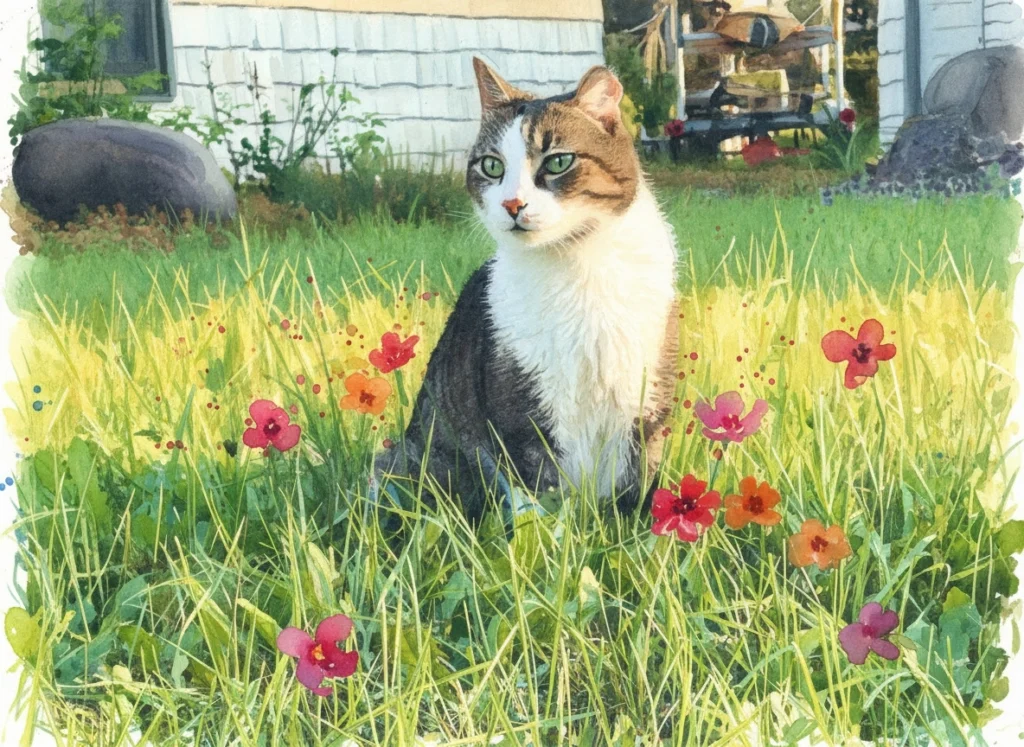
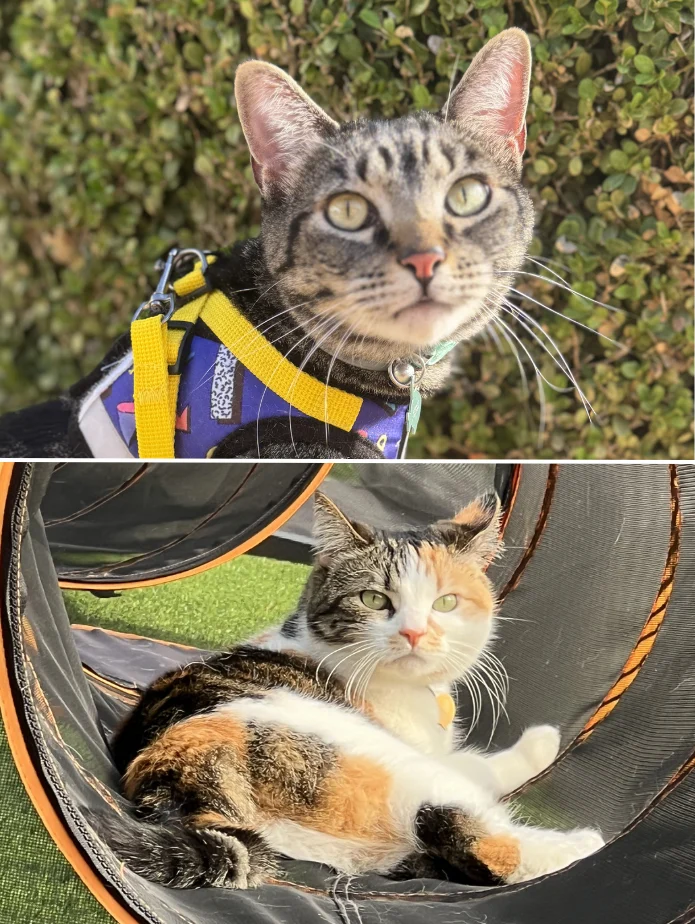
Darcie (our calico) and Koda (our tabby) are both five years old. My family adopted Darcie after she was discovered in our backyard. Darcie was only three weeks old at the time and became our first cat. Not long after, we adopted Koda, then three months old, to be a companion for Darcie. Darcie is smart, curious, knows what she wants (which is primarily to be outside in her catio), and her trust and affection have to be earned. Koda is goofy, vocal, highly food motivated, and cuddly (master biscuit maker). Koda enjoys the outdoors but does not crave it like Darcie; his most ardent desires are saved for food alone.
Favorite Toys: They have access to multiple cat trees, tunnels, and scratch poles. These cats have an abundance of toys consisting of balls, mice, cat wands, and kicker toys. They are also quite fond of their heating pads.
Why They’re Indoor Cats: My family’s house is in the foothills of California, and there are coyotes, bobcats, raccoons, and bears aplenty. It is simply not safe to have them out and about, especially at night. Not to mention car hazards, feral cats looking to pick a fight, and also transfer potential illnesses. As an avid birder, I am staunchly against outdoor cats because I am well aware of the extreme collective damage outdoor cats have on our wildlife.
How They Explore Outdoors: My father and sister, both mechanical engineers, built a catio. It was designed to fit on a porch that the cats have access to through a small doggy door. It was designed with a sturdy wooden frame and lined with chicken wire to keep raccoons out. It is not permanently affixed to the side of our house. There is ample height to feature multiple hidey-holes and shelves for climbing. They also have a pop-up tent that functions like a portable catio.
The Secrets to a Purr-fect Life Indoors for Cats
A happier, healthier, longer life for our much-loved feline companions starts with keeping them safe indoors. ABC’s flock and their cat coworkers show that with attention, engagement, and affection, cats can truly thrive — and are even happier — inside.
If you do opt to let your cat explore outdoors, your supervision is the key to a safe experience. Whether you opt for a good old-fashioned leash and harness, a swanky stroller, or even a kitted-out catio, keeping your kitty close by and under your watchful eyes is the best way to ensure they stay safe, and the wildlife around them do, too. Even in a catio or fully fenced-in yard, wildlife can wander too close, and the consequences could be dangerous.
Looking for more ways to make life inside even sweeter for your cat? Find some of our best guidance for indoor cats. You can go the extra mile and sign our call to local elected officials to support policies that encourage responsible pet ownership.